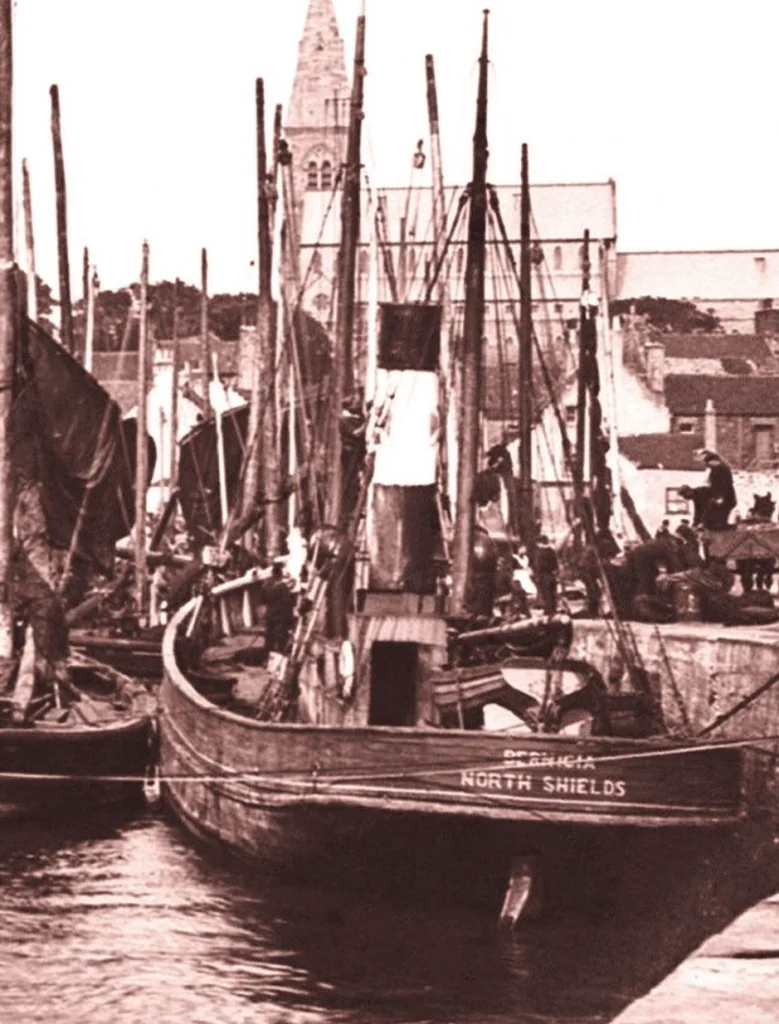
Today is the 121st anniversary of the loss of the fishing vessel Bernicia. She’d sailed from Cellardyke on the east coast of Scotland, and was lost in storms in the North Sea on or around 12th February 1900. On board were 10 men, one of whom was my Great Grandfather Alexander Murray.
Last year I wrote this about the men who were lost.
In it I mentioned a woman, Agnes Henderson, who lost her husband, her father and a cousin in that one tragedy. From that one boat there were eight men from the same village, leaving 6 widows and 22 children without a father. To say nothing of grieving mothers, sisters and girlfriends.
It was a hard life for the women – there was no way for a boat to communicate with the shore back then. The only way they would know that everything was OK was when the boats arrived back safely into harbour.
The family story is that my Great Grandmother, who had eight children still living at the time, waited on the pier head for the Bernicia to return. When she knew it wouldn’t be coming in she turned to go, wrapped her shawl around her, and said, ‘The living need me more than the dead’. She then scrubbed her house from top to bottom. Four of her five sons became fishermen in their turn.
The women were very independent, and this shows itself in many ways.
Firstly, they tended to still be known informally by their own name after they married. Because of the way children were named, there could be several men with the same name, so after they were married the men would have the woman’s surname in brackets after their own name. For example, when Jock Murray married Lisbeth Robertson, everyone continued to call her Lisbeth Robertson and he was known as Jock Murray (Robertson).
Secondly, they looked after the money. When the fishing was good the men would hand over their share, or their wages, and be given pocket money – enough to keep them in tobacco and newspapers. It was the women who made sure the rent was paid and there was food on the table. And a wise woman would make sure she had enough put by to see them through when the fishing wasn’t so good.
Decisions had to be made when the men were away. My grandmother moved house, without being able to tell her husband where she’d moved to.
They were an integral part of the business of fishing. It was the women who mended the nets, it was the women who gutted and packed the herring, it was the women who knitted the woollen underclothes and the blue ganseys that the fishermen wore.
Thirdly, they became political. In the 1940s my Grandmother was the second ever female Town Councillor in Scotland. And I think it’s no coincidence at all that the first ever female Town Councillor in Scotland was from the same village.
To this day, my mother still says you should never complain about the price of fish.
Scroll all the way down to Follow, Share, Like or Comment on this. And check out my ‘Sixty and Me’ badge.
I always reply to Comments from nice people.